
 EN
EN  EL
EL  DE
DE  ES
ES  HU
HU  FR
FR  PL
PL 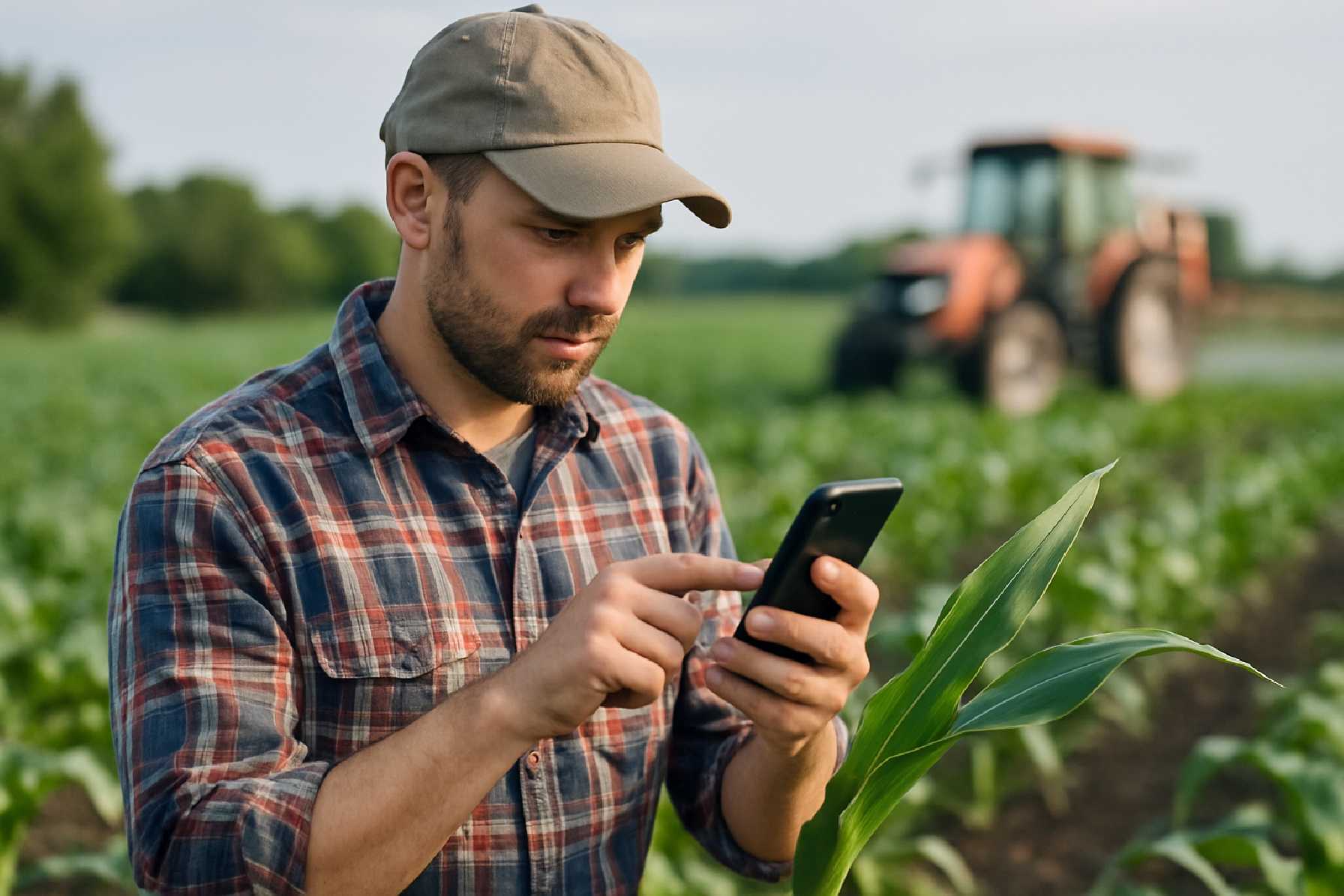
How Mobile App Development Is Transforming Agriculture
Agriculture is no longer managed only in the field, the barn, or the marketplace. Increasingly, it is managed on a phone screen. From crop planning and irrigation decisions to livestock monitoring and commodity pricing, mobile tools are changing how agricultural work is organized, measured, and improved.
This shift matters for two audiences at once. For farmers and agribusiness operators, apps can support faster decisions and better resource use. For product leaders, software teams, and digital strategists, agriculture has become a serious and demanding domain for mobile app development, one that requires practical design, reliable data handling, and software that performs under real operational pressure.
The promise is clear, but so are the constraints. Agricultural apps do not succeed simply because they are digital. They succeed when they fit seasonal work, poor connectivity, variable device quality, and the need for trustworthy recommendations. In that sense, agriculture is an unusually revealing test case for mobile product development: if an app can prove useful there, it is usually because the product strategy and execution are sound.
Why Agriculture Has Become a Strong Use Case for Mobile Application Development
The case for agricultural apps starts with a simple operational reality: farming depends on timing, conditions, and margins. Small changes in weather, soil moisture, disease pressure, input costs, or market prices can affect outcomes quickly. Mobile software is well suited to this environment because it puts current information in the hands of people who need to act on it immediately.
That may sound obvious, but the practical effect is substantial. A field manager can compare weather forecasts before scheduling irrigation. A livestock producer can receive alerts tied to animal health or fertility data. A grower can review planting records and yields from previous seasons while standing in the field, not back at a desktop computer hours later.
This is where mobile app design becomes more than an interface exercise. In agriculture, speed of use and clarity are central product requirements. Many users are not looking for a broad software platform to explore casually. They are trying to answer a direct question: Should I irrigate today? Is disease risk rising? Are grain prices moving enough to justify action?
That need for immediate, usable answers explains why agriculture continues to attract investment in mobile software development. It also helps explain projected market growth. Grand View Research reported that the global mobile apps market for agriculture was valued at $756.8 million in 2020 and projected to grow at a compound annual growth rate of 17.2% from 2021 to 2028. The exact pace may vary over time, but the broader trend is well established: agricultural software is becoming a more important part of digital product strategy.
What Agricultural Apps Actually Do
The most useful agricultural apps are not trying to do everything at once. They usually solve a few operational problems well, often by combining field data, records, alerts, and workflow support into one mobile experience.
One major category is crop management. Applications in this area help users track planting, fertilization, spraying, harvesting, and yield performance. Bayer’s Climate FieldView is one example often cited in the market. It combines historical and real-time data to support decisions related to planting, fertilizer application, and harvest timing.
Another category is plant health monitoring. Plantix, for example, uses image recognition and artificial intelligence to help identify plant diseases and pest issues. The value here is not that AI replaces agronomic expertise. It is that software can help surface early warning signals faster, especially where access to on-site specialists is limited.
Livestock management is another strong fit for mobile application development. Apps such as iCow and Kinku have supported farmers with information related to animal health, breeding, and prices. Moocall HEAT, which works with sensors, illustrates a different model: the app becomes the visible part of a larger connected system, delivering alerts and summaries to a phone while data is collected elsewhere.
There is also a commercial layer to agricultural software. Market-focused apps help users track input pricing, benchmark performance, and evaluate selling decisions. Farmers Business Network, for instance, has built a network connecting tens of thousands of farms and offers data on input prices and farm commerce. In these cases, the app is not only a record-keeping tool. It is part of a broader business infrastructure.
Efficiency, Productivity, and Sustainability: The Core Value Proposition
Most claims made about agricultural apps fall into three broad categories: efficiency, productivity, and sustainability. Those claims are reasonable, but they should be understood carefully.
Efficiency gains often come first. If farmers can access weather forecasts, market prices, irrigation data, or task logs in one place, they spend less time collecting information and more time acting on it. For a digital product manager, this suggests that integration is often more valuable than feature volume. One app connected to useful data sources may outperform a larger but fragmented toolset.
Productivity is the next layer. Better timing and more accurate decisions can improve yields or reduce losses. But productivity benefits are rarely automatic. They depend on data quality, usability, and whether the recommendations match actual field conditions. A sophisticated app that produces confusing dashboards or generic advice may not improve outcomes at all.
Sustainability is perhaps the most strategically important, especially as water use, emissions, and input efficiency become more closely watched. According to IDC, users of yield management apps can reduce water consumption by 10% to 20% on average. Research cited from EPRI suggests that yield management apps can also contribute to a 10% to 20% decrease in carbon emissions. These figures should be read as evidence of potential, not guarantees for every operation. Results depend on adoption, farm type, local conditions, and implementation quality.
Still, the direction is significant. When software helps apply water, fertilizer, or crop protection products more precisely, it can reduce waste and environmental pressure while also protecting margins. That is one reason agricultural app strategy increasingly overlaps with sustainability reporting and long-term operational resilience.
What Makes Agricultural App Development Different
For teams used to consumer apps or standard enterprise tools, agriculture introduces a more complex operating environment. Connectivity is one of the first challenges. Rural areas may not have stable high-speed coverage, which means offline access, background synchronization, and graceful error handling are not optional features. They are central product requirements.
Device conditions matter too. Agricultural users may rely on older Android hardware, share devices across workers, or use phones in dusty, wet, bright, or gloved conditions. That changes interface decisions. Buttons may need to be larger. Navigation must be obvious. Screens should remain legible in sunlight. Workflows should be short and forgiving.
Data integration is another critical factor. Many agricultural apps need to connect with sensors, machinery platforms, mapping tools, weather feeds, or back-office systems. This is where custom mobile app development can become necessary. Off-the-shelf workflows may be enough for basic record keeping, but not for operations that need equipment telemetry, geospatial analysis, or organization-specific compliance reporting.
Security and privacy also deserve careful treatment. Agricultural data can be commercially sensitive, especially when it includes yield figures, land boundaries, pricing behavior, or operational benchmarks. Good practice includes secure authentication, controlled access, encryption in transit, and clear data permissions. Formal compliance requirements vary by region and use case, so teams should distinguish between general security best practices and sector-specific legal obligations.
Choosing the Right Technical Approach
There is no single best technical model for agricultural apps. The right choice depends on the product’s purpose, user environment, hardware integrations, and maintenance plan.
Native development can make sense when an app requires deep integration with device capabilities, demanding performance, or highly refined offline behavior. Native iOS app development or Android app development may also be the better path when teams need tight control over platform-specific features.
Cross-platform app development can be attractive when budgets are constrained, release parity across platforms matters, and the product requirements are relatively consistent. For many agricultural tools, this approach can work well, especially in the early stages of a product, provided the team does not underestimate testing, offline behavior, and hardware variability.
The trade-off is familiar. Cross-platform development may reduce duplicated effort, but native development may offer stronger optimization in demanding scenarios. Neither model is universally superior. If the app relies heavily on external sensors, background tasks, complex mapping, or high-performance data visualization, the technical decision deserves close scrutiny rather than a default framework choice.
That same caution applies to app development cost. Agricultural stakeholders often ask for pricing early, but cost depends heavily on scope: number of platforms, field data sources, hardware integrations, mapping features, analytics, user roles, compliance needs, testing demands, and ongoing support. A basic field-record app and a connected agronomic decision platform are not comparable products, even if both are described casually as “an agriculture app.”
The Role of UX, Analytics, and Maintenance
Many agricultural apps fail not because the idea is weak, but because the product does not fit the user’s daily rhythm. A farm operation is busy, seasonal, and often unpredictable. That means mobile app design should prioritize essential actions over dense dashboards and long onboarding flows.
A good agricultural app often does three things well. It reduces the number of steps needed to record or retrieve information. It presents alerts in plain language. And it makes the next action obvious. If disease risk is high, what should the user check? If irrigation data changes, what decision should follow? Product clarity matters more than visual complexity.
Analytics also need discipline. Usage metrics such as daily sessions or feature taps can be useful, but in this sector they should be tied to operational outcomes. Are users completing records in the field rather than later? Are alerts acted on? Are recommendations trusted enough to influence behavior? Mobile product development in agriculture should measure utility, not just engagement.
Maintenance is equally important. Weather APIs change, mobile operating systems update, sensor vendors revise firmware, and app store requirements evolve. An agricultural app is not a one-time build. It is a long-lived operational product that needs regular updates, support, testing, and data governance.
How AI, IoT, Blockchain, and AR Fit Into the Future
The source text points to four future directions: AI and machine learning, IoT integration, blockchain, and augmented reality. All four are relevant, but they are not equally mature in every use case.
AI and machine learning are already influencing agriculture, especially in disease recognition, forecasting, and recommendation systems. Their strongest value usually comes from pattern detection across large datasets. Their limitation is that recommendations are only as reliable as the underlying data, training, and real-world validation.
IoT integration is arguably the most operationally important of the four. Sensors in fields, equipment, storage facilities, and livestock systems can feed apps with real-time data that a human could not collect manually at the same frequency. The challenge is less about whether IoT is useful and more about integration reliability, battery life, connectivity, and support.
Blockchain is most relevant where traceability across the supply chain matters. It may help document product movement and provenance, but it is not automatically necessary for every agricultural product. In many cases, the business process and data governance model matter more than the choice of ledger technology.
Augmented reality remains more experimental in this sector, but there are plausible applications. It could support equipment maintenance, guided inspections, or field training. Even so, AR should be treated as a use-case-driven capability, not a feature to add for novelty.
The Broader Impact Beyond the Farm
The significance of agricultural apps extends beyond individual productivity gains. These tools can improve access to information for smaller operators, support more consistent data collection, and reduce some of the historic advantages held only by large, well-capitalized farming businesses.
That does not mean software removes structural inequality. Devices, connectivity, training, and subscription costs still shape who benefits. But mobile tools can lower access barriers in meaningful ways. A farmer with a smartphone can now use services that once required desktop systems, extension visits, or expensive specialist support.
This is one reason agricultural software deserves attention from serious app development company teams and digital product leaders. The opportunity is not only commercial. It is also infrastructural. Useful software can reshape how knowledge is distributed in agriculture and how decisions are made at the edge of the network, where timing matters most.
Key Considerations for Building Agricultural Apps
| Area | Why It Matters | Main Trade-Off or Risk |
|---|---|---|
| Offline capability | Many users work in low-connectivity environments and still need reliable access | More complex synchronization, testing, and conflict handling |
| Platform choice | Native or cross-platform decisions affect performance, speed, and maintenance | No universal winner; the best option depends on integrations and product scope |
| Data integration | Value often depends on weather feeds, sensors, machinery, and farm records | External dependencies can increase cost, fragility, and support demands |
| User experience | Farm users need fast, practical workflows under real field conditions | Feature-heavy interfaces can reduce adoption and trust |
| Security and privacy | Operational and yield data may be commercially sensitive | Weak permissions or unclear data policies can undermine adoption |
| AI and automation | Can improve detection, forecasting, and recommendations | Overstated claims or poor data quality can lead to weak decisions |
| Maintenance | Apps need updates for APIs, devices, operating systems, and app stores | Underfunded maintenance can erode product reliability over time |
Questions Readers Should Ask Before Investing in an Agricultural App
Before starting or expanding an agricultural app initiative, readers should ask themselves a few practical questions:
- Which decision or workflow is the app meant to improve first: field records, crop health, livestock alerts, pricing, compliance, or something else?
- Will users need reliable offline access, shared-device support, or compatibility with lower-cost Android devices in rural conditions?
- How much of the product’s value depends on integrations with sensors, machinery platforms, mapping systems, or third-party data providers?
- What evidence will show that the app is genuinely useful: time saved, better timing of interventions, reduced input waste, stronger records, or improved margins?
- Does the team have a realistic plan for maintenance, security updates, analytics, and platform changes after the first release?
Conclusion
Mobile apps are becoming an important layer of agricultural infrastructure. They help farmers organize information, respond faster to changing conditions, and make more precise decisions about crops, livestock, inputs, and markets. The result can be better efficiency, stronger productivity, and more sustainable resource use.
But the real story is not simply that agriculture is “going digital.” It is that useful software in this sector must be exceptionally practical. It has to work in the field, with uneven connectivity, variable devices, and decisions that carry immediate operational consequences.
For professionals interested in mobile app development, agriculture offers a compelling example of how software creates value when product strategy, user experience, and technical execution are aligned. The tools that succeed here are not the ones with the most features. They are the ones that turn data into decisions people can trust and use when it matters.