
 EN
 EL
 DE
 ES
 HU
 FR
 PL
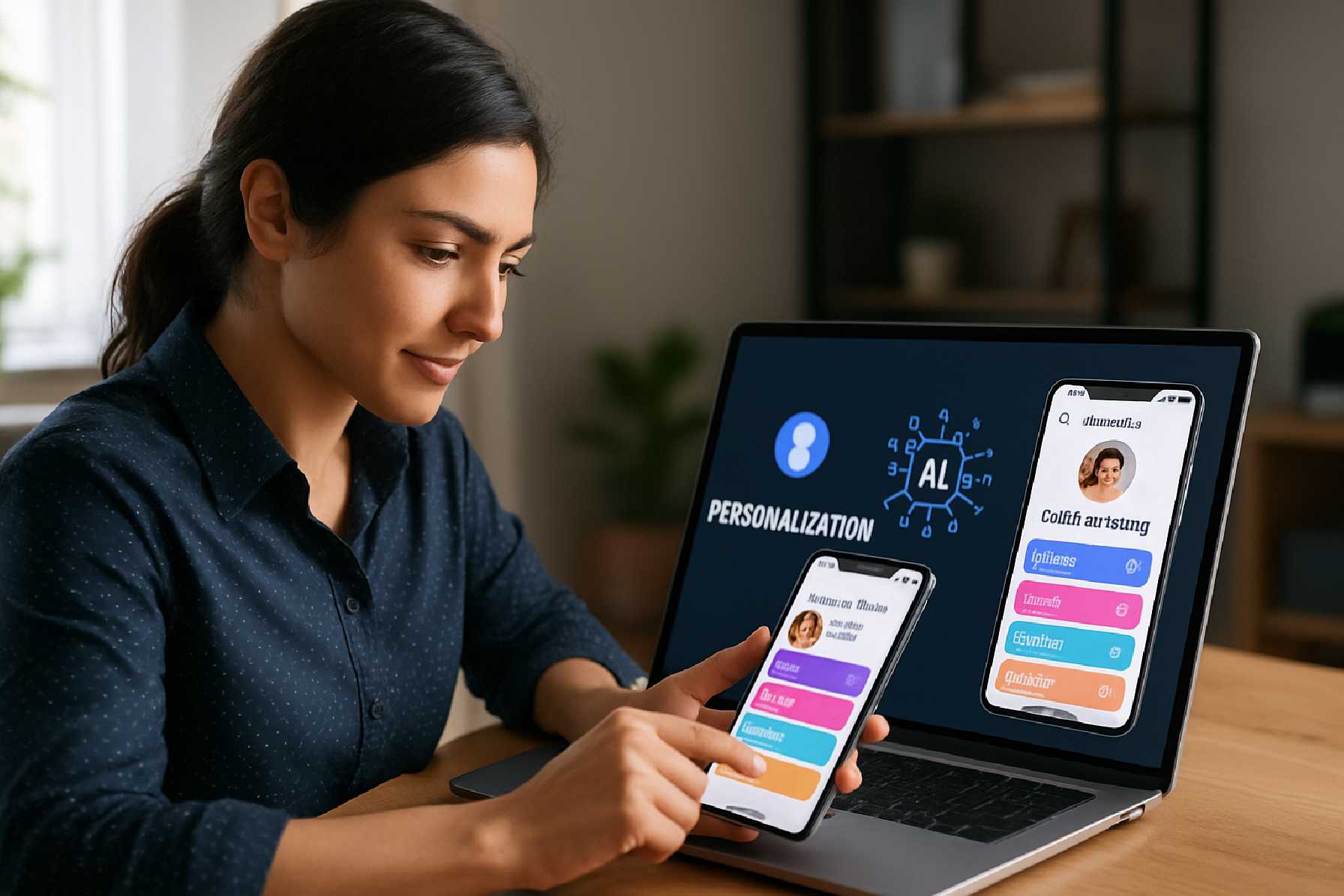
How AI Is Reshaping Mobile App Development Through Personalized App Experiences
Personalization is no longer a novelty in digital products. For many users, it is the baseline expectation. They expect streaming apps to recommend the next show, retail apps to surface relevant products, fitness apps to adjust plans based on progress, and banking apps to highlight the information that matters most at a particular moment.
For teams working in mobile app development, that expectation creates both an opportunity and a constraint. Artificial intelligence can help apps become more useful, timely, and adaptive. But poorly implemented personalization can feel intrusive, confusing, or simply inaccurate. The challenge is not just to add AI features. It is to build app experiences that are meaningfully personal, technically reliable, and responsible in how they use data.
The best AI-driven personalization rarely announces itself loudly. It works in the background, making the app feel easier to use. It reduces friction, shortens decision time, and helps users reach their goals faster. In practical terms, that might mean ranking content differently for different users, adjusting onboarding flows, predicting the most likely next action, or changing notification timing based on behavioral patterns.
This is where AI becomes strategically important in mobile application development. It can turn a generic interface into a system that responds to context, history, and intent. But the path to that outcome usually depends less on flashy models than on disciplined product thinking, strong data practices, and clear boundaries.
What personalization with AI actually means
In product conversations, “AI personalization” is often used too broadly. In reality, it can describe several different capabilities.
At the simplest level, a rules-based app can personalize content using explicit logic. A music app might promote downloaded content when the device is offline. A travel app might highlight airport information on the day of a flight. That is useful personalization, but it is not necessarily AI.
AI enters when the app starts learning from patterns rather than relying only on fixed rules. A recommendation model may infer which products, videos, or workouts are likely to interest a user based on previous interactions. A language model may tailor in-app guidance according to what the user is trying to accomplish. A predictive model may estimate churn risk and trigger an intervention at the right moment.
These systems do not “know” the user in a human sense. They identify statistical patterns in behavior and context. That distinction matters. It helps product teams stay realistic about what AI can do well, what it does poorly, and where human oversight is still necessary.
Why personalization matters in mobile app development
Mobile apps compete in a crowded environment where attention is limited and switching costs are often low. If an app feels generic, users may never return after the first few sessions. Personalization can improve retention by making value visible earlier and more consistently.
It can also improve business outcomes. In commerce, personalization can support conversion by showing more relevant products or offers. In media, it can increase time spent and repeat usage. In health and education, it can make progress feel more achievable by adapting content to the individual rather than forcing everyone through the same path.
Major platforms have shaped this expectation. Recommendation systems are now central to how users experience Netflix, Spotify, YouTube, Amazon, and TikTok. Their approaches differ, and their scale is unusual, but the broader lesson applies widely: relevance is part of user experience, not an optional feature layered on top.
That said, smaller teams should be careful not to imitate large consumer platforms blindly. The right personalization strategy depends on the product category, data availability, regulatory environment, and user trust. A healthcare app and a shopping app do not have the same tolerance for experimentation, and they should not be designed as if they do.
Start with a clear product problem, not an AI feature list
One of the most common mistakes in custom mobile app development is starting with the model instead of the user problem. Teams decide they want recommendations, predictive analytics, or conversational AI before they define the moment of friction they are trying to improve.
A better approach is to ask a simpler question: where does the app currently ask too much of the user?
If users struggle to find relevant content, ranking and recommendation may help. If they abandon onboarding because setup feels long and repetitive, AI may be useful for progressive profiling or adaptive onboarding. If users receive too many generic notifications, a prediction model may help identify the right message and timing.
This is not just a product management issue. It affects architecture, analytics, and app development cost. An AI feature that does not solve a concrete problem often requires new pipelines, ongoing model tuning, and governance work without producing a proportional return.
Experienced mobile app developers usually know that the most effective personalization projects begin with one measurable use case. They are scoped tightly, tested carefully, and expanded only after teams see evidence that the intervention improves real behavior.
The data question: personalization is only as good as its inputs
AI personalization depends on data, and not just in large quantities. It depends on relevant, well-structured, well-governed data.
In many apps, the most valuable signals are fairly ordinary: searches, taps, session length, completed tasks, skipped items, purchases, location permissions, device type, and time of day. The challenge is turning these signals into a usable picture of intent without collecting more than the product genuinely needs.
That is where teams need to balance ambition with discipline. Data minimization is not only a privacy principle; it is often a product advantage. Collecting excessive data can increase compliance burdens, complicate user consent, and create noise that makes models less useful.
Regulatory expectations also matter. In Europe, the General Data Protection Regulation sets strict requirements around personal data processing and user rights. In mobile ecosystems, platform policies add another layer. Apple’s App Tracking Transparency framework changed how apps access cross-app tracking data, and both Apple and Google maintain rules governing privacy disclosures, permissions, and data handling in their app stores.
For product leaders, the practical takeaway is straightforward: personalization should be designed with privacy and consent from the start, not patched in later. Users are more likely to accept tailored experiences when the value exchange is clear and the controls are understandable.
Choosing the right AI approach
Not every personalization problem requires the same kind of AI. In fact, using the wrong tool can increase complexity without improving outcomes.
Recommendation engines are useful when users face a large content or product catalog. These systems can rely on collaborative filtering, content-based methods, or hybrid approaches. Their strength is ranking relevance at scale. Their weakness is the “cold start” problem: they often struggle with new users or new items until enough interaction data accumulates.
Predictive models are useful when the app needs to estimate the likelihood of a future action, such as conversion, churn, or cancellation. They can support interventions that are timely and efficient. But they also require careful evaluation, because false positives can annoy users and false negatives can hide real opportunities.
Natural language AI can personalize support, search, or coaching experiences. In some products, a conversational interface lowers friction and helps users navigate complexity. Still, language systems can be inconsistent, expensive to run, and difficult to control in high-risk contexts. They should be introduced with clear boundaries and fallback paths.
Context-aware personalization, which uses real-time signals such as location, activity, or device state, can be especially powerful in mobile software development because smartphones are rich with contextual data. Yet context can also become invasive if it feels too precise or arrives at the wrong moment. A timely intervention feels helpful; an overfamiliar one can feel unsettling.
On-device AI versus cloud-based personalization
For iOS app development and Android app development, one of the most important architectural choices is where inference happens: on the device, in the cloud, or through a hybrid approach.
On-device AI can improve privacy, reduce latency, and allow certain features to work offline. It is especially useful for lightweight personalization, ranking, or classification tasks where immediate response matters. It can also reduce the need to transmit sensitive data externally.
Cloud-based AI is often more flexible for complex models, centralized experimentation, and frequent updates. It may be easier to maintain when recommendations depend on large shared datasets across many users. But it introduces network dependence, backend cost, and additional considerations around security and compliance.
The trade-off is rarely ideological. It is practical. If the app needs low-latency adaptation with privacy-sensitive data, on-device processing may be the better fit. If the product relies on large-scale collaborative patterns and constant model refinement, cloud infrastructure may be more appropriate. Many teams in cross-platform app development end up using a hybrid pattern, keeping sensitive or immediate logic on-device while handling heavier model training and ranking in the backend.
Design matters as much as the model
A personalized experience is not only a machine learning problem. It is also a mobile app design problem.
Users need to understand why the app is showing certain content or prompting a certain action. In some cases, a brief explanation can increase trust. “Recommended because you completed three beginner lessons” is more reassuring than a mysterious feed that changes with no visible logic.
Good design also gives users some control. That might mean letting them reset recommendations, choose interest categories, mute certain topics, or turn off specific kinds of personalization. Full control is not always necessary, but some degree of user agency usually improves trust and reduces the sense that the app is making opaque decisions.
Accessibility should be part of the conversation as well. Personalized interfaces can become less usable if they create inconsistent navigation, unpredictable layouts, or content ordering that confuses assistive technologies. Adaptation should improve clarity, not undermine it.
Measurement: what success really looks like
Teams often evaluate AI personalization through surface-level metrics such as click-through rate. Those metrics matter, but they do not tell the full story.
A recommendation engine that increases clicks but reduces completion quality may not be helping. A notification model that lifts opens but increases opt-outs may be doing long-term harm. Success should be tied to outcomes that reflect user value as well as business value: retention, task completion, repeat conversion, content completion, reduced support burden, or improved satisfaction.
This is why controlled testing remains essential. A/B testing, holdout groups, and phased rollouts help teams understand whether the personalized experience is genuinely better than the baseline. Analytics should also be segmented. A feature that works well for frequent users may perform poorly for newcomers, and the reverse is also common.
In many cases, the practical work of AI in the app development process looks less like a breakthrough and more like ongoing refinement. Teams test, observe, tune, and occasionally pull back. That is normal. Personalization is not a one-time release. It is a product system that requires maintenance.
Risks that product teams should not overlook
AI personalization has clear upside, but the risks are equally real.
Bias is one concern. If a model trains on historical behavior, it may reinforce patterns the business should actually challenge. A marketplace app, for example, might overexpose already popular sellers and make discovery harder for new entrants.
Overpersonalization is another issue. When an app narrows choices too aggressively, users can miss relevant options outside their usual patterns. This is not only a media problem. In commerce, finance, education, and wellness, too much narrowing can reduce exploration and limit user agency.
There is also the operational burden. Models drift. User behavior changes. Data pipelines break. Platform permissions evolve. A feature that felt accurate at launch can decay quietly if teams do not monitor it. This is one reason organizations often benefit from involving product, engineering, analytics, compliance, and design from the start rather than treating personalization as a side experiment.
For companies evaluating partners, that broader capability matters. A team offering mobile app development services should be able to discuss not only model integration, but also privacy, analytics, experimentation, maintenance, and app store implications.
A practical rollout strategy for AI-driven personalization
The most credible path is usually incremental.
Start with a narrow use case where relevance clearly matters and where the result can be measured. Build the data foundation carefully. Define what signals are needed, what permissions are justified, and what success metrics matter. Launch to a limited segment, compare performance against a non-personalized baseline, and review not just engagement but user feedback and operational cost.
From there, expand gradually. Many successful teams move from rules-based personalization to lightweight models, then to more advanced systems only when the product has enough data and enough evidence to justify the complexity.
This staged approach is especially important in mobile product development because app updates, device variability, network conditions, and store review requirements all affect what can be deployed smoothly. A simpler version that works reliably is often more valuable than an ambitious version that is hard to maintain.
The near future: more adaptive apps, higher expectations
It is reasonable to expect AI personalization to become more common across mainstream apps. Improvements in on-device processing, better development tooling, and broader familiarity with AI interfaces are lowering the barrier to entry.
But future adoption does not mean every app should become hyper-personalized. In some categories, predictability and consistency remain more important than adaptation. Enterprise, public sector, healthcare, and regulated financial products often need stronger controls and clearer explanations than entertainment or shopping apps.
The stronger prediction is not that every app will become an AI assistant. It is that users will increasingly judge apps by whether they respect context, reduce effort, and handle personal data responsibly. Personalization will matter, but trust will matter just as much.
Summary of the main decisions
| Issue | Recommended approach | Main benefit | Main risk or trade-off |
|---|---|---|---|
| Defining personalization goals | Start with one measurable user problem | Better focus and clearer ROI | Too narrow a scope may limit early impact |
| Data collection | Use relevant signals and minimize unnecessary data | Lower privacy risk and cleaner inputs | Less data can reduce model sophistication |
| Model choice | Match AI type to the use case: recommendations, prediction, or language | Improves practical fit | Wrong model adds cost without value |
| Architecture | Choose on-device, cloud, or hybrid based on latency, privacy, and scale | Balances performance and flexibility | Hybrid systems can be harder to maintain |
| User experience | Add transparency and limited user controls | Builds trust and usability | Too many controls can complicate the interface |
| Measurement | Track retention, task success, and quality outcomes, not just clicks | More accurate view of product value | Requires stronger analytics discipline |
| Operations | Monitor model drift, feedback, and policy changes continuously | Protects long-term reliability | Creates ongoing maintenance overhead |
Questions readers should ask before building AI personalization
Before adding AI-driven personalization to an app, product and engineering teams should ask themselves a few direct questions:
- What specific user friction are we trying to reduce, and how will we know whether personalization actually improves it?
- Do we have the right data to support this feature, and are we collecting it in a way that is necessary, transparent, and compliant?
- Would a rules-based approach solve this problem well enough before we invest in a more complex AI system?
- Should this logic run on-device, in the cloud, or as a hybrid system based on privacy, latency, and maintenance needs?
- What happens when the model is wrong, and how will users recover, correct it, or opt out?
Final thought
AI can make apps feel remarkably personal, but that outcome is rarely the result of AI alone. It comes from disciplined mobile app development, careful UX decisions, strong analytics, and a clear understanding of where personalization helps rather than distracts.
The most effective teams do not treat AI as a decorative layer. They use it to make apps more relevant, more efficient, and easier to trust. In a market where users have endless alternatives, that may be the most important form of personalization of all.